Skip to Main Content
Close Icon

Main Menu

METALWORKING FLUID
ANALYSIS TESTS


Metalworking Fluid Analysis

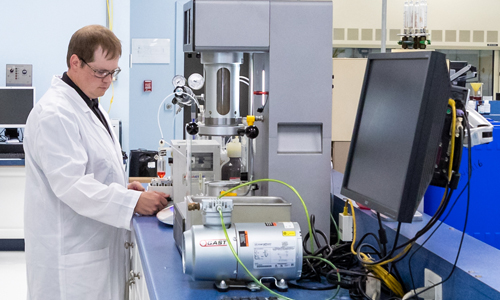
AMSOIL Industrial provides a complete range of industry-standard and proprietary metalworking fluid tests — microbiological and contamination; corrosion and wear-related; and fluid concentration and stability — to evaluate fluid integrity, detect contaminants and ensure your systems are running within optimal operating parameters.


Lubricant Analysis for Oil-Based Metalworking Fluids

  • Elemental Analysis (ASTM D5185, ASTM D7751) – Provides a concentration of elements that may be present in a sample. The three likely sources of these elements are formulated additive packages, machine wear and contamination.
  • Flash Point (ASTM D92) – A measure of the temperature at which an oil will ignite (flash) when exposed to an open flame.
  • Fourier Transform Infrared Spectroscopy (FTIR) (ASTM E2412, ASTM D7371) – The infrared spectrum is used to determine additive concentration and levels of oxidation. It can also identify contamination.
  • Quench Curve Analysis (ASTM D6200) – Charts six key data points to maintain stable quenching conditions in an oil tank.
  • Total Solids (Internal Method QC16) – Measures the amount of sludge, dirt or other insoluble contaminants.
  • Viscosity (ASTM D445) – The measure of a lubricant’s resistance to flow. Viscosity is often the most important physical property of a lubricant. Changes in viscosity indicate improper servicing, dilution, contamination or breakdown of a lubricant.
  • Water (ASTM D1744, ASTM D6304) – Water promotes lubricant breakdown and component corrosion. Samples are flagged for water contamination at levels greater than 500 parts per million.


Lubricant Analysis for Water-Dilutable Metalworking Fluids

  • Bacteria and Fungi (Internal Method QC07) – Identifies microbial contamination that produces foul odors, shortens fluid life and poses health risks.
  • Tramp Oil (Internal Method QC50) – Detects contamination from hydraulic, way or lube oils that can destabilize emulsions and support microbial growth.
  • pH (ASTM E70) – Measures acidity or alkalinity. Abnormal pH often signals bacterial growth, contamination or incorrect concentration.
  • Chlorides by Titration (ASTM D512) – High chloride levels can accelerate corrosion of metal components.
  • Concentration by Alkalinity Titration (ASTM D1121) – Assesses reserve alkalinity and dilution accuracy of in-use coolants.
  • Concentration by Refractive Index (ASTM D1218) – Quickly measures dissolved solids for concentration control.
  • Electrical Conductivity (ASTM D1125) – Identifies ionic buildup that may cause emulsion instability, residue formation and corrosion.
  • Emulsion Stability (Visual Inspection) – Confirms emulsion is properly formed and stable.


Control Limits

Because each test provides different information, it may carry an upper limit, a lower limit, both or neither. The following examples help provide some context on limits:

  • Viscosity (fluid property) – both an upper and lower limit define the normally expected operating range.
  • Wear metal (i.e., copper in a hydraulic fluid) – only an upper limit is in place to warn against excessive wear.

In cases where conditions vary widely or the presence of an element is sporadic, results may be reported for informational purposes without limits.

All limits, results and data provide guidance that should be applied in context to your equipment, environment, application, tolerances and any other considerations needed. AMSOIL Industrial representatives can help provide guidance. Working together, we are confident that AMSOIL Industrial lubricant analysis reports will help diagnose problems, optimize your fluid and avoid loss of valuable production time.

Fluid compatibility and other tests available upon request.


Get Started Today

Enhance the efficiency and reliability of your operation with AMSOIL Industrial Metalworking Fluid Analysis. Contact our team of application engineers at [email protected] to learn more or implement a customized fluid analysis program tailored to your needs.

Take the first step toward protecting your equipment and improving operational performance with our trusted analysis solutions.