WIND TURBINE LUBRICATION: PROTECTING GEARBOX LIFE AND MAXIMIZING UPTIME
Your wind turbine gearbox is among the most complex and expensive components within the nacelle of a turbine unit. It's also the most vulnerable to failure. When lubrication fails, everything it touches can fail with it — bearings, gear teeth, seals — and then your production schedule. The right wind turbine lubrication strategy can make the difference between maintaining a 20-year asset and a recurring maintenance crisis.
AMSOIL Industrial is a long-standing participant in the wind turbine lubricants market, supplying synthetic wind turbine oil and wind turbine grease to onshore and offshore operators alike. With experience onsite and up-tower, our wind energy engineers understand common asset challenges and provide guidance and solutions to help you mitigate risk.
AMSOIL Industrial works alongside your reliability team to design a comprehensive lubrication program built for the 20-year operating life of modern turbines. By leveraging advanced synthetic chemistry, we shift your operation from reactive up-tower repairs to predictive, data-backed maintenance.
AMSOIL INDUSTRIAL WIND TURBINE LUBRICANTS
Protect gearboxes, bearings, and pitch/yaw systems across your entire fleet with engineered wind turbine oil and wind turbine grease designed to eliminate operational bottlenecks at every stage of the drivetrain:
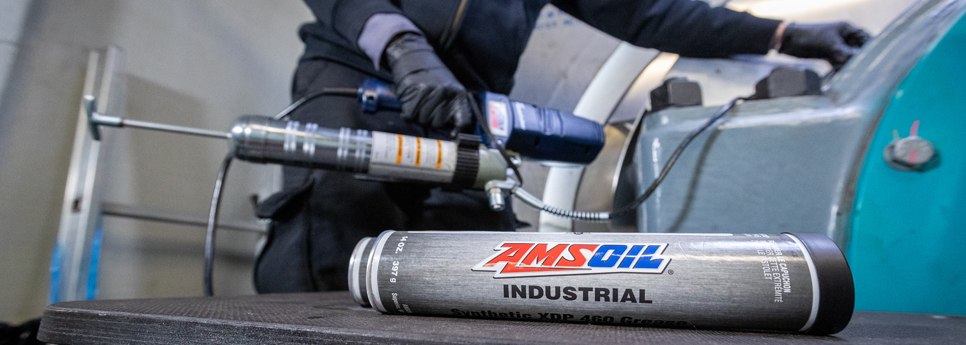
Synthetic XDP Grease Main Bearing Grease
Maximum protection in extreme temperatures for main shaft and generator bearings under continuous oscillating load.
WIND TURBINE INDUSTRY COMMON PAIN POINTS AND CHALLENGES
Most operators treat gearbox oil as an interchangeable commodity. However, in remote and offshore environments, suboptimal lubrication creates severe operational and financial risk. When reviewing performance across wind turbine equipment, reliability teams frequently battle these critical common pain points:
Logistical Constraints: Complex up-tower operations require massive coordination of specialized pumping equipment and personnel, turning a routine oil change into a high-cost logistical event.
Additive Depletion: Standard oils and lubricants not designed for wind applications break down faster under the extreme shear stress of utility-scale gearboxes, forcing frequent, costly change-outs.
Water Absorption: Moisture reduces lubricant performance and protection, increasing the risk of corrosion and component wear — especially in offshore and high-humidity environments.
Micropitting: Contaminants and inadequate film strength cause permanent gear-tooth damage that reduces efficiency and leads to expensive downtime and repairs.
A single gearbox failure is a silent profit killer long before it becomes a catastrophic component failure. Crane mobilization costs alone can exceed $100,000, not including technician climb-time and weeks of lost production.
REQUEST A WIND TURBINE LUBRICATION TECHNICAL AUDIT
Stop guessing on gearbox and bearing health. Complete your operational details below to route an immediate request directly to our Wind Energy Engineering Team for an onsite technical audit or a laboratory fluid analysis.
AMSOIL SYNTHETIC PT SERIES GEN2 VS. STANDARD GEAR OIL PERFORMANCE COMPARISON
To protect your gearbox from intense shear stress, moisture and thermal cycling, our synthetic wind turbine oil outperforms conventional fluid baselines across every critical operational metric:
Rapid separation, water content often below 100 ppm
Poor separation, elevated corrosion risk
Cold-Weather Performance
High viscosity index for stable cold-start protection
Thickens and loses flow at low temperatures
Oil Change Interval
Up to 7–15 years with monitoring
Typically 3 years or less
Filterable Cleanliness
Filterable to 3 microns, ISO 4406 16/14/11 at packaging
Requires prefiltering before installation
WIND TURBINE OIL CAPACITY
Efficient lubrication management starts with understanding the scale of the asset. Wind turbine oil capacity varies significantly based on the megawatt (MW) rating and the specific gearbox design from manufacturers.
Turbine Class
Typical Oil Capacity (Gallons)
Typical Oil Capacity (Liters)
Sub-MW / Legacy (<1 MW)
40 – 75 gal
150 – 285 L
Utility-Scale (1.5 – 2.5 MW)
80 – 125 gal
300 – 475 L
High-Capacity Onshore (3 MW+)
150 – 250+ gal
570 – 950+ L
Offshore Units (6 MW – 15 MW)
300 – 800+ gal
1,135 – 3,000+ L
In high-capacity systems, even a small percentage of residual oil can impact performance — in a 200-gallon system, leaving 5% of degraded oil behind introduces approximately 10 gallons of contaminated fluid into the new fill. AMSOIL Industrial procedures ensure large sumps are fully evacuated, coordinate the specialized pumping equipment needed to move these volumes up-tower efficiently, and maximize the time between oil changes to lower your total cost of ownership.
Your 4-Step Custom Implementation Plan
Transitioning your fleet to an advanced wind turbine oil and grease strategy requires a structured execution plan that respects your operating schedule and up-tower access constraints:
Turbine Audit: Our engineers review your plant's current lubrication procedures, alarm logs, and past oil analysis to identify at-risk turbines before they fail.
Impact Quantification: We help you calculate the true cost of your current downtime, including crane mobilization, specialized labor, and lost AEP, to justify the shift to a premium synthetic strategy.
Tailored Chemistry Selection: We recommend a program tailored to your specific gearbox manufacturer (ZF, Winergy, Moventas, etc.), ensuring full seal compatibility and the water-resistance properties required for your environment.
Continuous Optimization: Once the changeover is complete, we provide up-tower training for your team and establish a routine monitoring schedule, moving your facility from reactive repairs to a predictive maintenance model.
Build a More Reliable Wind Operation
If your gearbox reliability is impacting your bottom line, your current lubrication strategy is failing you. AMSOIL Industrial provides the field engineering backbone, backed by decades of up-tower experience, to stabilize your fleet and protect your margins.
Use the technical form above to launch your audit request today, or connect directly with our distribution team coordinates.
RESOURCES
Gain deeper insights into the benefits of AMSOIL Industrial solutions with our comprehensive document library:
Maximize Reliability. Reduce Downtime. Extend Gearbox Life.
Request a technical audit to review operating conditions, discuss micropitting, moisture contamination and lubricant-related reliability concerns, and determine whether a deeper evaluation would be useful for your wind turbine fleet.
How do AMSOIL Industrial lubricants prevent micropitting in wind turbine gearboxes?
AMSOIL Industrial gear oils are engineered with high-quality synthetic base oils and advanced anti-micropitting technology that minimizes friction and metal-to-metal contact under extreme-pressure shock loading, protecting against surface fatigue and ensuring maximum gear life.
How often should a wind turbine oil change be performed?
Interval depends on gearbox design, load profile and environment, but data-backed synthetic chemistry can extend a wind turbine oil change interval well beyond the 3-year cycle common with standard oils — in some cases to 7, 10 or 15 years.
Why is water separation important in wind turbine oil?
Moisture reduces lubricant performance and protection and increases the risk of corrosion and component wear. Oils engineered for rapid water separation help keep the system cleaner and support more stable long-term protection, especially offshore.
Which components benefit most from a wind turbine grease review?
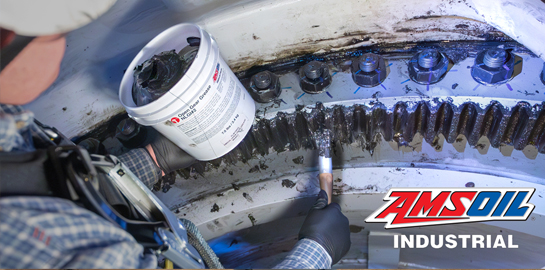
Pitch bearings, yaw bearings, main shaft bearings, generator bearings and open yaw gears are common starting points because they operate under oscillating loads and long re-lubrication intervals, and are closely tied to up-tower service frequency.
Hi, Anonymous
Your browser is outdated.
Thank you for visiting www.amsoilindustrial.com. Certain parts of this website may not function with Internet Explorer. To continue shopping with us, please update your browser using one of the options below.